Today let’s talk about the appearance of play in early childhood. Close your eyes for a minute and think about play. What do you see? A game of tag? A child with a doll? Kiddos playing with trucks? Play often looks this way, but what if I told you these aren’t the only behaviors exhibited in play?
All over the world, parents and experts alike see patterns of repeatable behaviors in early childhood play. When children repeat these behaviors in various situations, they are developing physically, emotionally, and mentally. This development helps build your child’s schema, or framework, for future learning. While it may not look like play to you, these behaviors are valuable and should not be simply tolerated, but encouraged!
So, what behaviors am I talking about? Some of the common behaviors are rotation/circulation, trajectory, enclosing/enveloping, positioning, connecting and transforming. Over the next couple of weeks, let’s examine these each individually and some activities that can help you support your child in their exploration! Today we will start with circulation/rotation.

Spinning, rolling, and swinging, oh my! The vestibular, proprioceptive, auditory, and visual senses work together. These labels designate important sensory systems in humans that often work behind the scenes, shaping the way our body takes in and processes information. The vestibular system controls a person’s balance, posture, gaze stabilization, and spatial orientation.
Spinning in circles is a fantastic activity allowing children to gain body awareness and figure out where their “center” is located. This allows them to perform cross body skills down the road like following a line of text across the page, writing, and even throwing a ball!
When your child spins on the swing, rides a merry-go-round at the playground, or uses a Playschool Sit n Spins at home (Aff. Link: https://amzn.to/3a7auIk ), the centrifugal force activates the fluid-filled cavities in the inner ear. This allows the brain to determine the orientation of the head which in turn develops grounding and sustained attention to a task at hand.
Remember, if children incessantly spin in circles, it is because their bodies crave that stimulation. If they roll and tumble and stand on their heads, it is because they need that sensory input. Create spaces where they can do these activities anytime the need arises. If your child is having a hard time focusing or simply seems off, sending them to spin or swing can often help bring them back to a space of focus and self control. (Play really is a superpower, y’all.)
Now that you know what it is (and that the spinning top you are raising isn’t broken), how can you support this method of play? I’m so glad you asked! Providing plenty of opportunities for your child to get this type of input is the first step. Play scarves for twirling, hula hoops, jump ropes, tumbling mats, crash pads, balance boards, exercise balls, and grassy hills are all wonderful tools to use in your play arsenal.
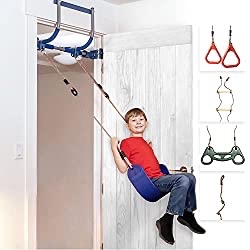
An indoor swing, like the Gym One, is amazing! We have one in our home and it has served us wonderfully. We read Mr. Popper’s Penguins as a read aloud in one sitting while my son used the swing one day. It is also a really nice tool to have for those moments when you can just feel the energy radiating from your little one’s body and getting outdoors is simply not an option. It is absolutely fantastic and I can not recommend it enough! (Aff. Link: https://amzn.to/2YgZPYW )
If you have met one child, you have met one child. When I say this I simply mean, all children are their own individual human beings and will develop and experience the world at their own pace, in their own way. Some children will dabble in multiple behaviors at once and some will take a deep dive into one behavior and then over time begin to explore another. Be a student of your child, study them, learn their quirks and preferences and you will develop a bond and life together that feels smoother and more enjoyable.
Until next week, exercise your superpower – PLAY!
 The Superpower of Play